Outraged by abuse at women’s prison, Democratic senators call for creation of public advocate

NPR WHYY
Colleen O’Dea, NJ Spotlight
February 17, 2021


This story originally appeared on NJ Spotlight.

New Jersey needs a new public advocate to help protect inmates and people in other state-run facilities, three lawmakers said, arguing more oversight is needed after last month’s assault on inmates at the women’s prison and the apparent failure of the state to reach a settlement with federal authorities over problems at the facility.

The state had a public advocate , but the office fell victim to politics and was last active more than a decade ago. The three top Democratic state senators, all critical of the leadership of New Jersey’s prisons, plan to create a new advocate. The position would be more limited in its scope of authority but also independent of the whims of governors who may not like the work the office undertakes.

Senate Majority Leader Loretta Weinberg (D-Bergen) and Sens. Linda Greenstein (D-Mercer) and Nellie Pou (D-Passaic) said they plan to introduce legislation soon creating an independent public advocate with investigative and legal powers over incidents in state and county correctional facilities, veterans homes, psychiatric hospitals, developmental centers and community-based programs and under state guardianship. They are also calling for the establishment of community advisory boards to provide oversight of each institution and hold quarterly public meetings with administrators to discuss issues and complaints.

Spurred by lack of DOJ settlement

Last week’s announcement came a day after the senators learned the state Department of Corrections did not reach a settlement with the U.S. Department of Justice over a scathing report issued last spring about conditions at the Edna Mahan Correctional Facility for Women, the lawmakers said. Corrections Commissioner Marcus Hicks told a Senate committee last September that there was a tentative agreement. A DOJ spokeswoman declined to comment on the matter.

Had the sides reached a consent agreement, federal monitors most likely would have been inside Mahan and could potentially have averted the assaults in January  that left one female inmate with a fractured eye socket and another with a concussion, the senators said. Three corrections officers have been charged in connection with the assault that continues to be the subject of investigations by the state attorney general’s office and an outside lawyer brought in by Gov. Phil Murphy.

“The assaults on women inmates on January 11 came nine months after the Justice Department found that abuses by corrections officers violated the civil rights of inmates, and five months after Corrections Commissioner Marcus Hicks said the administration was reviewing a proposed agreement,” Weinberg said. “If federal monitors were assigned to Edna Mahan, the 32 corrections officers who are now suspended would have had to think hard before deciding to don riot gear, brutally assault women inmates or brazenly try to cover it up.”

She added that a “truly independent public advocate” is needed to provide oversight and advocacy for those in institutions because their administrators often try to prevent the public disclosure of abuse or other problems.

DOJ documents sex abuse, other problems

The DOJ report was the result of an investigation that began in April 2018. It found systemic problems at Mahan that allow sexual abuse to occur undetected and undeterred and that discourage prisoners from reporting abuse. At least eight correctional police officers at the Hunterdon County facility have been charged with sexual assault or misconduct since 2015.

During a September hearing before the Senate Budget and Appropriations Committee, Hicks said he expected the settlement agreement with the DOJ to be finalized soon and that federal officials had acknowledged steps the DOC had taken to improve the climate at Mahan, which held about 400 inmates as of last month. Hicks said the department had taken a number of steps to make the facility safer and had changed the “toxic culture” there.

Weinberg called Hicks’ statements about changes at Mahan “fiction” several times during a news conference last week as she, Greenstein and a number of advocates called for reforms, including the replacement of Hicks and a federal takeover of the women’s prison.

The entire Senate Democratic delegation, as well as some Republicans, have called for Hicks to be replaced. One Republican Assemblywoman is preparing legislation calling for his impeachment.

“Commissioner Hicks led us to believe that the Justice Department’s proposed settlement with ‘very specific recommendations’ was being reviewed by counsel and that an agreement was imminent,” Greenstein said. “Six months later, the fact that there is still no agreement makes it clear that protecting vulnerable women locked in prison from physical and sexual abuse is not a priority for this administration.”

Call for DOJ’s details

Pou called on the DOC to immediately release the DOJ’s recommendations to the Legislature and the public, as well as all correspondence between the two agencies related to the proposed settlement.

“The Legislature and the people have a right to know what the Justice Department recommended and why women inmates at Edna Mahan have been allowed to continue to fear for their physical safety for months while this Corrections Department finds excuses not to implement reforms that could protect them,” Pou said. “The coverup has gone on long enough at all levels.”

If an advocate were already in place, it is unlikely that the tentative settlement would still be a secret, Pou said.

The senators are proposing that the independent advocate have broad investigatory powers, the ability to enter institutions at any time and meet with staff, inmates and residents and the ability to file lawsuits if corrective actions are not undertaken. They are working with the nonpartisan Office of Legislative Services to determine the best option to provide a bipartisan reporting structure and independence for the new agency, similar to the state auditor or the State Commission of Investigation.

They do not want to create an advocate like the former Department of the Public Advocate, which was created as a cabinet-level agency reporting to the governor in 1974. Gov. Christie Whitman abolished the office in 1994. While he was governor, Sen. Richard Codey (D-Essex) signed a law recreating the agency in 2005, only to have Gov. Chris Christie eliminate it again five years later. During its existence, the public advocate worked to improve conditions at the state’s psychiatric hospitals and enforce standards in nursing homes.

Independence deemed essential

“One thing we’ve learned from past experience is that the public advocate cannot report to the governor or another Cabinet official,” Weinberg said. “The new agency must be truly independent to be effective — and to survive.”

A new, independent advocate would watch out for the needs of all those in state institutions, not just in prisons. And having community boards in place, as well, might have helped mitigate the spread of COVID-19 in state facilities last spring.

“We need boards that include advocates, experts, family members, former inmates or residents, union or staff representatives and community leaders who know what is happening in these institutions and would hold regularly scheduled public meetings with administrators to discuss issues and complaints,” said Greenstein. “If we had such a board at the Paramus Veterans Home, we would have known about the pandemic sweeping through the facility much sooner.”

To date, 155 residents of the state’s three veterans homes have died of COVID-19, with more than half those deaths at the Paramus site, according to the state. The facility was so overwhelmed in April that the National Guard was sent in to help quell the outbreak. An investigation into what happened is ongoing.

Lawsuit Filed Denouncing Assaults on Trans & Queer Prisoners at CCWF

Transgender, Gender Non-Conforming and Queer Prisoners say “me too”: Lawsuit Filed Denouncing Assaults at The Central California Women’s Facility

On November 9, 2017 four people of color – a transgender man, a gender non-conforming person and two queer female prisoners – who were all at one time incarcerated at the Central California Women’s Facility (CCWF), filed a lawsuit against the State of California and the California Department of Corrections and Rehabilitation (CDCR).  The lawsuit denounces two vicious assaults where correctional officers beat up, sexually harassed, hurled homophobic and transphobic insults at, and tormented the plaintiffs.  The plaintiffs were then denied medical treatment for their injuries and were prevented from filing grievances about the assaults they had experienced.  The assaults are particularly reprehensible because the plaintiffs are all survivors of sexual trauma and violence and were assaulted while advocating for their basic human rights.

The assaults originally took place on November 11, 2015, when Stacy Rojas, a gender non-conforming former prisoner was brutally attacked by correctional officers after warning that they intended to complain to the prison’s internal investigation unit about repeated harassment by guards regarding their gender.  Rojas’ cell mates were subsequently attacked when they indicated that they would report the use of excessive force against Rojas.  All three were then confined for nearly twelve hours in small programming cages and subject to sexually humiliating and abusive treatment.  This included having their clothing cut off of their bodies, having their breasts and chests stomped on by guard boots, and being told that male guards could “show them what a real man is” while making reference to the size of their penises.  They were then put in solitary confinement without cause and without receiving medical treatment for their injuries or being allowed to use the restroom.

When all three plaintiffs attempted to use the internal system of accountability designed to report abuses inside prisons, they were obstructed. Their original complaints were claimed to have been lost and then mentioned in response to future complaints as a reason to not investigate follow-up reports. Furthermore, they were never informed by the CDCR of conclusive results of any investigation into the incidents. The legal complaint submitted by the law offices of Siegel and Yee seeks the creation of a system of true accountability for excessive use of force, sexualized violence, and targeting of transgender, gender non-conforming and queer prisoners by guards against prisoners as well as freedom from retaliation for reporting such violations.

Released in January 2017, Rojas is now part of the legal advocacy team working on the case, they are committed to making a difference for those still in prison: “Most of us are inside because of the histories of violence and abuse that we experienced and then got caught up in.  Just because we are in prison doesn’t mean that we should not have our basic human rights protected.  I do not want anyone else to go through what I did.  My fellow inmates use to tell me that I was singled out because of my gender and because I advocated for myself and others.  We have a right to stand up for ourselves and to take care of each other.”

On January 5, 2017, Isaac Medina, a transgender prisoner at CCWF, was denied access to his medication.  When he asked why he was being denied, he was then attacked violently by multiple guards.  At the time of the attack, Medina was in a wheelchair and during the incident he was also denied the accommodations he was entitled to under the Americans With Disabilities Act (ADA).  During the course of the attack he endured physical brutality and sexually humiliating treatment, such as having his pants pulled down to his ankles throughout the attack and having his head smashed against a brick wall.  Medina, was also placed in a programming cage and not allowed to use the bathroom after the attack.  Further, he was denied medical treatment for his injuries.

According to Sara Kershnar of the California Coalition for Women Prisoners, “These incidents are part of a pattern of abuse at CCWF, part of a climate of increasing violence employed by correctional officers at CCWF against transgender, gender non-conforming and queer women prisoners.  They represent a backlash against hard-won legal rights for trans people in prison, such as the right to access hormone therapy.  They reflect officer resentment about changing cultural norms regarding gender identity.  They also re-traumatize people who have suffered sexual violence and homophobia and transphobia before they were incarcerated.”

This is a moment of exploding social awareness in this country about the pervasiveness of sexual  harassment and violence by those in power against vulnerable people.  This case shines a light on predatory practices by correctional officers that target people who are marginalized within women’s prisons based upon their gender identification and sexuality.  The plaintiffs’ demand systemic policy changes in the prisons to prevent such types of abuse and prejudice in the future.

##

SUPPORT CCWP’S IMPORTANT WORK!

PLEASE GIVE GENEROUSLY TO CCWP

Dear CCWP Community,

2017 has been a hard year for all people who seek justice in the world.  At the same time, it has been a year when we have all pushed our limits to resist a system that is ramping up white supremacy, anti-immigrant fever, misogyny, transphobia, xenophobia and hate of all kinds. CCWP has responded by intensifying our work on behalf of people living in California’s women prisons – rejuvenating and expanding our visiting teams, pushing forward with campaign to DROP LWOP sentencing, and building a new CCWP chapter in Los Angeles.

One of CCWP’s major highlights of 2017 was our statewide retreat in September. There, we reaffirmed our collective commitment to nurture creative forms of radical sanctuary inside and outside of prison and prioritize mutual aid and grassroots advocacy.

At the retreat, we welcomed members of our new CCWP chapter based in Los Angeles, a major step forward in building our capacity across the state.  Our growing L.A. chapter reflects the tremendous amount of dedicated work that has been done with people at CIW and their loved ones over the past couple of years in response to the suicide and in-custody death crisis there.

In 2017 CCWP worked inside and outside of prisons to accomplish many things:

  • Launched the Drop LWOP campaign!  We sent thousands of signed postcards to the Governor urging him to commute LWOP sentences.  This year, he has started to grant commutations for the first time, including two women we work with, Sue Russo and Liz Stroder. Almost 30 other people at CCWF and CIW who filed petitions for commutations have now been interviewed. We also partnered with people at CIW to hold a powerful LWOP town hall inside the prison! Over 100 people participated, building strength and community for the 36 people at CIW serving LWOP
  • Pressured the California State Auditor to release a highly critical report of CDCR suicide prevention and response policies, focusing on CIW. The report confirmed everything CCWP had been saying for years – but its proposals for change didn’t go far enough.
  • Filed a lawsuit, working with Siegel & Yee law firm, against the CDCR for egregious incidents of excessive force used by correctional officers at CCWF against gender non-conforming and trans survivors of sexual trauma and violence.
  • Stepped up to support immigrant women in detention by demonstrating at the Contra Costa West County Detention Facility on International Women’s Day, offering solidarity to hunger strikers protesting horrendous conditions at Northwest and Adelanto detention centers, and supporting CCWP member Ny Nourn who was recently released on bail!
  • Began the Share the Fire reading circle with members inside and outside of women’s prisons. All members read the same materials focused on race, gender and prisons and exchange reflections about these thought provoking pieces.
  • Supported the passage of many propositions and legislative bills, including SCR 48 (the Felony Murder Rule Change); SB 394 (the Youth LWOP bill); AB 1008 (expanding Ban the Box); and SB 310 (The Name and Dignity Act for Incarcerated Trans People).
  • Initiated FireStorm, a new educational project to build international solidarity with women and trans people targeted by the U.S.-led Prison Industrial Complex around the world.
  • Continued building our visiting teams, parole support, Fired Up empowerment group in the San Francisco jail, and The Fire Inside newsletter (now in its 21st year of publication!)

All of this crucial work requires resources of many different sorts. Your donation will help us strengthen these efforts in 2018:

  • Support the salaries and stipends for our staff members.
  • Sponsor expenses for prison visits including car rentals, gas and food for the people we visit.
  • Provide stipends for the formerly incarcerated members of our Speakers’ Bureau.
  • Contribute printing and mailing costs for The Fire Inside.

We cannot do this without you, our community! Please accept an invitation to be part of this work by:

  • Becoming a monthly sustainer
  • Making a generous one-time contribution
  • Planning a legacy gift through a bequest, a living trust or a beneficiary designation

PLEASE GIVE GENEROUSLY TO CCWP!

For 22 years, CCWP has been challenging the impact of state, racist and gendered violence in prisons and on the streets.  There has never been a more important time to come together to dismantle the systems that promote violence and hate and build community based on justice and love. Thank you for supporting us in these efforts!


DROP LWOP! LETTER TO GOVERNOR BROWN

Dear Friends and Colleagues:

We are writing to ask you to join with California Coalition for Women Prisoners (CCWP) in our statewide campaign to DROP LWOP and secure sentence commutations for all those serving Life Without the Possibility of Parole (LWOP). LWOP is an inhumane sentence which denies people the possibility to rehabilitate and change.

We are asking Governor Brown to use his executive powers to commute the almost 5,000 people serving LWOP sentences — including nearly 200 women and transgender people in CA women’s prisons — to parole-eligible sentences. Because CCWP has advocated for the civil and human rights of people in CA women’s prisons for 22 years, we focus on the impact of life without parole sentencing on the 200 people serving LWOP in women’s prisons.

Will you join us? We are looking for organizations and individuals to sign on to the letter below as a first step in expressing support for this campaign.  Please feel free to contact info@womenprisoners.org or (415) 255-7036 x 4 with any comments, questions, or concerns.

Thank you,

California Coalition for Women Prisoners

 Dear Governor Brown,

As grassroots, advocacy, and social justice organizations, we are writing to urge you to commute the sentences of all people serving Life Without Parole (LWOP) in California’s prisons to parole-eligible sentences.

Life Without Parole sentencing is increasingly being challenged and limited across the United States. We believe that life without parole is inhumane. It denies that people have the capacity to change, grow and be rehabilitated, and thus is known as “the other death penalty” by those serving it and by their families.

As you know, many states, including California, are legislating against sentencing youth to Life Without Parole.[i] Now it is time to take action to mitigate the impact for all people sentenced to die in prison due to this endless punishment. While commuting a sentence does not guarantee release from prison, it does guarantee that each person will have the right to see the parole board in their lifetime, rather than being sentenced to a “living death.”

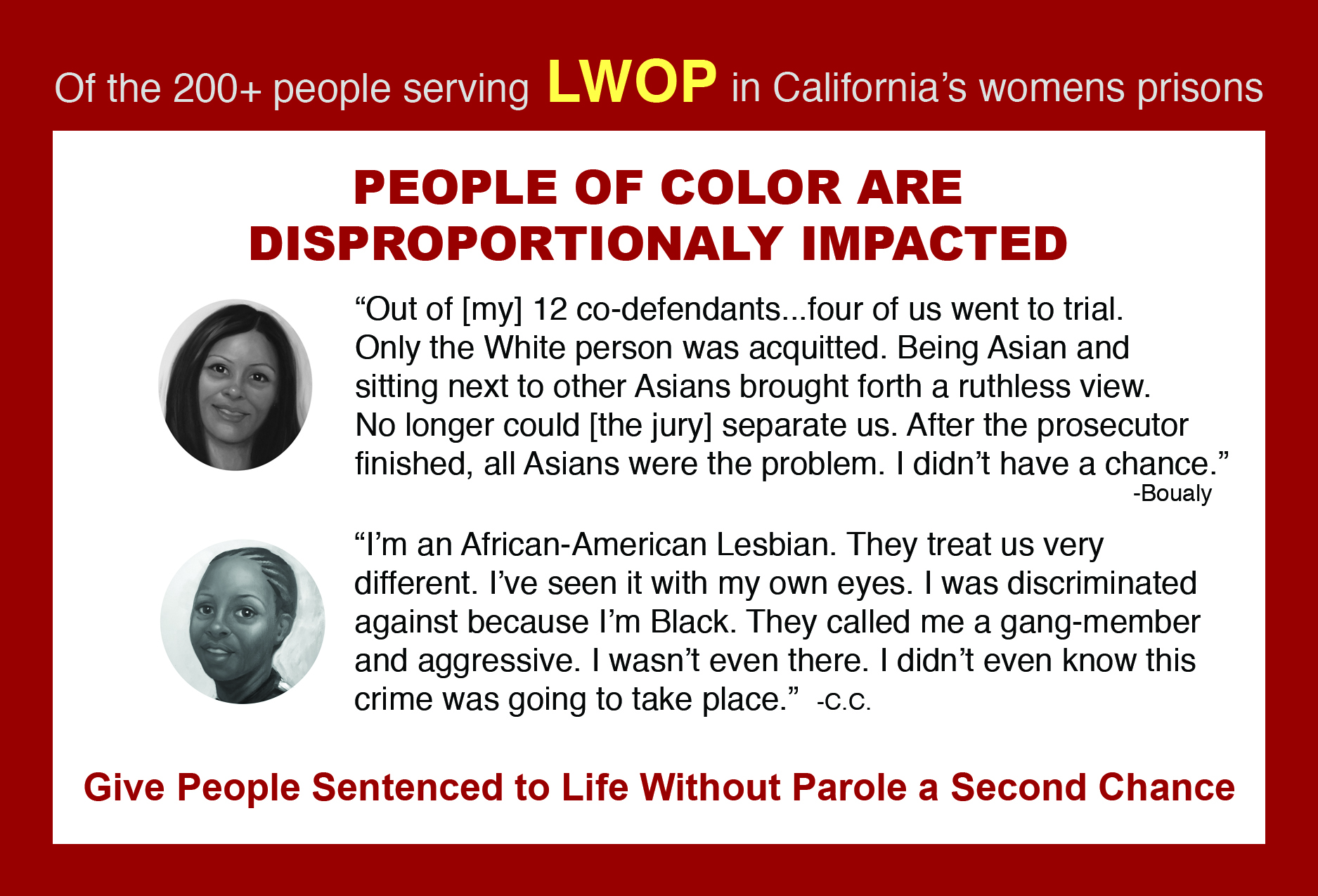
People of color are disproportionately sentenced to LWOP, revealing prosecutorial bias and racial discrimination.[ii] Of the nearly 200 people serving LWOP in CA women’s prisons, the overwhelming majority are survivors of abuse, including intimate partner battering, childhood abuse, sexual violence and sex trafficking. [iii] Additionally, the majority are first-time “offenders,” and had no record prior to being sentenced to Life Without Parole.

All 5,000 people serving LWOP in CA prisons are subjected to institutional discrimination, such as:

  • They are barred from rehabilitation programs, including the majority of state-run self-help programs because of their sentences.
  • Though they are required to pay restitution, they are only eligible for jobs that pay the lowest hourly wage, currently only eight cents per hour. Because they are barred from access to higher wage opportunities, they often cannot pay restitution, and this economic burden falls on their families.
  • They are ineligible for Elder Parole and Compassionate Release when aging and terminally ill.

We urge you to take a bold stance against Life Without Parole sentencing and let California serve as a model for the rest of our nation. Please continue to take leadership on this issue and commute all those sentenced to LWOP to parole-eligible sentences, initiate a process to eliminate life without parole from the California penal code, and provide people sentenced to LWOP with opportunities for rehabilitation and redemption.

Sincerely,

CLICK HERE TO SIGN ON TO THE LETTER TO DROP LWOP

THANK YOU AND PLEASE SHARE THIS LETTER!

Notes

[i] Senate Bill 9: Fair Sentencing for Youth. http://fairsentencingforyouth.org/legislation/senate-bill-9-california-fair-sentencing-for-youth/

[ii] “Racial Disparities in Sentencing,” American Civil Liberties Union, Hearing on Reports of Racism in the Justice System of the United States, Submitted to the Inter-American Commission on Human Rights, 153rd Session, October 27, 2014.
https://www.aclu.org/sites/default/files/assets/141027_iachr_racial_disparities_aclu_submission_0.pdf

[iii] Data gathered by CCWP members incarcerated at Central California Women’s Facility and California Institution for Women. This data reflects national statistics reported by the ACLU that nearly 60% of people in women’s prisons nationwide are survivors of physical or sexual abuse, and that survivors make up 94% of the population in some women’s prisons. “Prison Rape Elimination Act of 2003,” American Civil Liberties Union. https://www.aclu.org/other/prison-rape-elimination-act-2003-prea?redirect=prisoners-rights-womens-rights/prison-rape-elimination-act-2003-prea